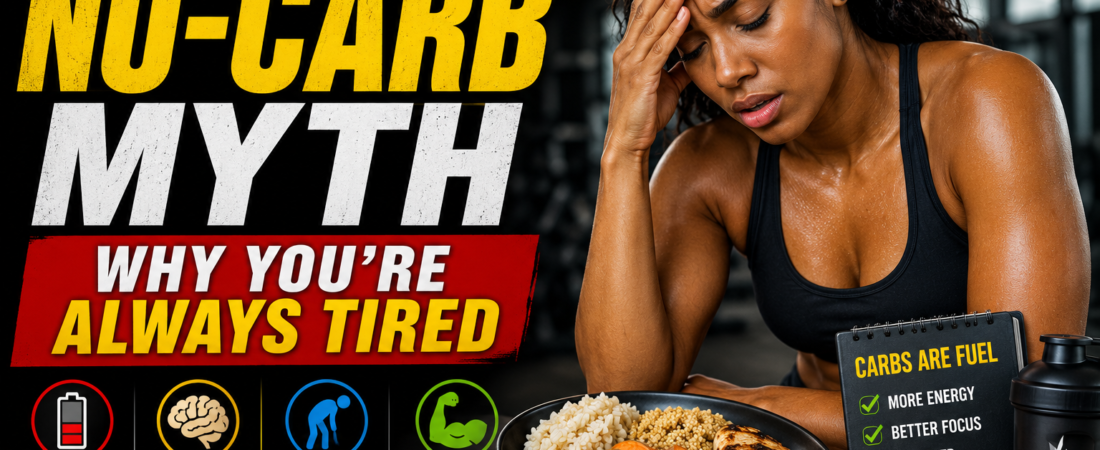
Skinny Fat Is a REAL Thing: Why Losing Weight Doesn’t Always Mean Looking Lean
Losing weight and improving your body composition are not the same thing.
You can step on the scale, see the number dropping, fit into smaller clothes, and still look relatively soft, flat, or lacking in visible muscle definition. This is commonly described as “skinny fat.”
The problem isn’t necessarily your body weight. The problem is what you’re losing to achieve that lower weight.
What Is “Skinny Fat”?
“Skinny fat” isn’t a medical diagnosis. It’s a common fitness term used to describe a person who may have a relatively normal or low body weight but carries more body fat and less muscle mass than desired.
Two people can weigh exactly the same and look completely different.
One may have:
- More muscle
- Less body fat
- Greater muscular definition
- A firmer appearance
The other may have:
- Less muscle
- A higher body-fat percentage
- Less definition
- A softer appearance
The scale doesn’t tell you that difference.
That’s why focusing exclusively on pounds lost can be misleading.
Weight Loss Isn’t Automatically Fat Loss
This is one of the biggest misconceptions in dieting.
When you create a calorie deficit, your body has to obtain energy from somewhere. The weight you lose can come from several sources, including body fat, glycogen, water, and, under some circumstances, lean tissue such as muscle.
The goal of a well-designed fat-loss program should therefore be more specific:
Lose primarily body fat while preserving as much muscle as possible.
That’s a very different objective from simply making the scale go down.
Where Low-Carb Diets Come Into the Conversation
Low-carbohydrate diets can produce rapid changes on the scale, particularly early in a diet.
Why?
Stored carbohydrate, or glycogen, is associated with water. When carbohydrate intake is substantially reduced, glycogen stores generally decrease, and some of that associated water is lost as well.
The result can be a dramatic initial drop in body weight.
But there’s an important distinction:
A rapid drop on the scale does not necessarily mean a rapid loss of body fat.
And a low-carb diet itself isn’t automatically bad. A properly structured low-carb diet can absolutely produce fat loss.
The concern is what happens when any restrictive diet is poorly designed.
If calories are excessively restricted, protein is inadequate, resistance training is absent, or the diet becomes difficult to sustain, the person may lose valuable muscle along with fat.
That’s where the “skinny fat” problem can emerge.
Smaller Doesn’t Always Mean Better
Imagine two people who both lose 20 pounds.
Person A
They lose primarily body fat while maintaining most of their muscle.
The result:
Smaller waist + preserved muscle + improved definition
Person B
They lose a combination of fat, water, and a significant amount of lean tissue.
The result:
Lower body weight + less muscle + potentially little improvement in definition
Both people lost 20 pounds.
But they didn’t achieve the same transformation.
The scale sees weight. It doesn’t see body composition.
Muscle Changes the Look of the Body
Muscle provides much of the shape and structure people associate with an athletic physique.
That’s why resistance training is so important during fat loss.
You aren’t simply trying to make the body smaller.
You’re trying to make the body better.
Maintaining or building muscle while reducing body fat can improve:
- Muscle definition
- Body shape
- Strength
- Physical function
- Metabolic health
- Overall appearance
This is why two people at the same body weight can look dramatically different.
Don’t Confuse Loose Skin With Muscle Loss
There’s another misconception worth clearing up.
If someone loses a significant amount of weight and develops loose skin, that doesn’t mean the muscle “shrunk and caused the skin to hang.”
Loose skin is influenced by factors such as the amount of weight lost, how long the skin was stretched, age, genetics, and skin elasticity.
However, losing muscle can make someone appear less full or defined underneath the skin, which can make loose skin more noticeable.
So the goal shouldn’t be to fear muscle loss—it should be to preserve muscle during the fat-loss process.
The Better Goal: Body Recomposition
Instead of asking:
“How much weight did I lose?”
Ask:
“What changed in my body?”
That’s the difference between weight loss and body recomposition.
A successful transformation should ideally move you toward:
Less body fat + maintained or increased muscle = better body composition
This is why a person’s measurements, strength, appearance, clothing fit, and changes in body composition can sometimes tell a much better story than the scale alone.
The Multibolic Principle
This is where a systematic approach becomes important.
Fat loss shouldn’t be based on guesswork, extreme restriction, or chasing the lowest possible number on the scale.
The objective is to create a nutritional and training system that helps you:
Eat appropriately.
Train progressively.
Preserve muscle.
Reduce body fat.
Monitor results.
Adjust when necessary.
Because weight loss is not the finish line.
Your goal should be to improve the quality of the weight you carry.
The Bottom Line
Skinny fat is REAL.
You can lose weight without developing visible muscle tone or definition. And while low-carb diets don’t inherently cause this problem, a poorly structured restrictive diet can contribute to muscle loss and an undesirable body-composition outcome.
Don’t measure success solely by how much lighter you become.
Measure success by how much better your body becomes.
Don’t just lose weight. Build a better body.
For eating plan that helps you control, lose weight or tone your body contact EP today.