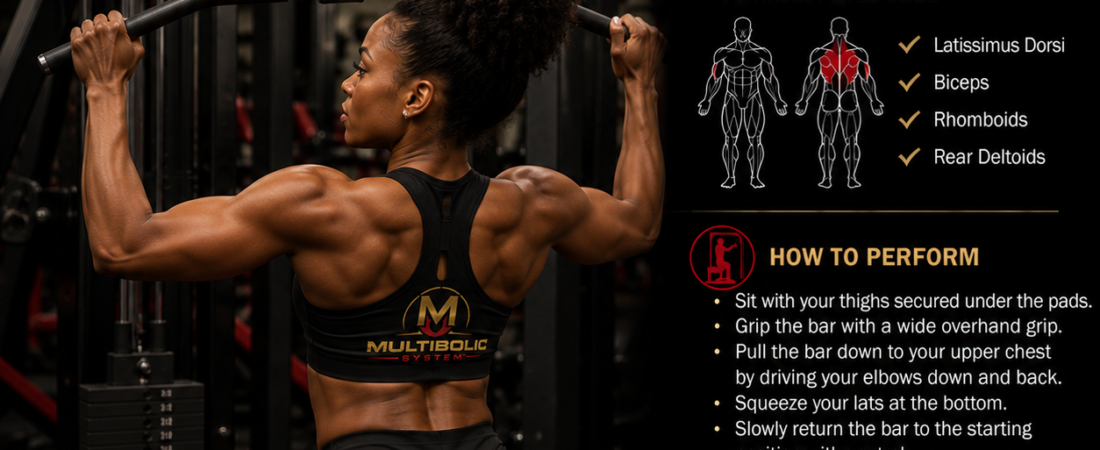
The Lat Pulldown
Build a Wider, Stronger Back by Learning to Pull With Your Lats—Not Your Arms.
If your goal is building the classic V-shaped upper body, few exercises are as effective as the Lat Pulldown.
It’s one of the best movements for developing width, improving posture, and strengthening the muscles responsible for pulling.
But despite its popularity, many people never truly train their back.
Instead…
They train their biceps.
The Lat Pulldown isn’t about pulling the bar down with your hands.
It’s about pulling your elbows down with your lats.
Once you understand that difference, everything changes.
Your Back Is Bigger Than You Think
Your back isn’t one muscle.
It’s an entire system of muscles working together.
The Lat Pulldown primarily develops the Latissimus Dorsi, the broad muscles that give your back its width.
It also strengthens many of the muscles responsible for posture and shoulder stability.
A strong back improves far more than appearance.
It improves how you move, lift, and live.
Muscles Worked
The Lat Pulldown is a compound pulling exercise that develops multiple upper-body muscles.
Primary Muscles
✔ Latissimus Dorsi
✔ Biceps
✔ Rhomboids
✔ Rear Deltoids
Supporting Muscles
• Trapezius
• Forearms
• Rotator Cuff
• Core
Together, these muscles create a strong, stable upper body capable of producing tremendous pulling power.
Why the Lat Pulldown Works
The Lat Pulldown teaches one of the most fundamental movement patterns in strength training:
Vertical pulling.
It develops:
✔ Back width
✔ Upper-body strength
✔ Grip strength
✔ Shoulder stability
✔ Pull-up performance
For many people, it’s also the perfect stepping stone toward performing their first pull-up.
Lead With Your Elbows
One of the biggest mistakes people make is thinking about pulling with their hands.
Instead…
Imagine driving your elbows toward your ribs.
Your hands simply hold the bar.
Your elbows guide the movement.
This small mental adjustment dramatically increases lat activation.
The back works best when you think about moving your elbows—not the bar.
Chest Up. Shoulders Down.
Posture matters.
Before you begin:
Lift your chest.
Pull your shoulders down.
Keep your spine tall.
Now pull.
Avoid rounding your back or leaning excessively backward.
Good posture allows your lats to produce maximum force while reducing unnecessary shoulder stress.
Control the Return
The repetition doesn’t end when the bar reaches your chest.
The return is equally important.
Allow your arms to extend slowly.
Feel your lats lengthen.
Maintain tension.
Don’t let the weight stack slam.
Controlled lowering creates additional muscle stimulus and reinforces better technique.
Stop Using Momentum
Many lifters lean backward until the exercise resembles a rowing movement.
Others jerk the weight using body momentum.
Neither builds the lats efficiently.
Reduce the weight if necessary.
Stay upright.
Control the movement.
Your muscles—not momentum—should perform every repetition.
The Mind-Muscle Connection
The lats are one of the hardest muscles to feel because you can’t easily see them.
That’s why visualization becomes important.
Imagine your elbows slicing through your sides.
Picture your lats shortening as you pull.
Feel the contraction at the bottom.
The stronger your connection with the muscle, the greater your ability to recruit it effectively.
A Strong Back Supports Everything
A stronger back improves nearly every major lift in the gym.
Deadlifts.
Rows.
Pull-Ups.
Farmer’s Carries.
Bench Press stability.
Overhead Press stability.
Even posture improves.
Strong backs don’t just create better physiques.
They create stronger people.
M.E.L.A. Says™
Don’t pull the bar to your chest. Pull your elbows to your sides, and your back will finally do the work it was designed to do.
Coach’s Insight
One of the biggest coaching moments I experience with clients comes during the Lat Pulldown.
They’ll often tell me,
“I only feel my arms.”
Then I make one simple adjustment.
I tell them to stop thinking about their hands.
Instead, I ask them to drive their elbows down while keeping their chest lifted.
Almost immediately, they feel their lats working for the first time.
That’s the power of proper coaching.
Sometimes the biggest improvements don’t come from changing the exercise.
They come from changing what you focus on.
Remember…
Your back isn’t built by pulling harder.
It’s built by pulling smarter.
That’s the philosophy behind the Multibolic System™.
Ready to Stop Guessing?
Reading articles helps you understand fitness.
Coaching helps you apply it.
If you’re ready to stop following fitness myths and start using a structured system built around your goals, I’d love to help you.
🚀 Start Your FREE 14-Day Multibolic Coaching Experience
Coaching:
https://multibolicsystems.com/coaching/
Your coaching experience includes:
✔ Body Composition Assessment
✔ Personalized Nutrition Analysis
✔ Calorie & Protein Planning
✔ Customized Training Program
✔ Progress Tracking
✔ Accountability Coaching
✔ Access to the complete Multibolic™ educational system
Stay Connected
YouTube:
www.youtube.com/@epluribusmasseyjr
Instagram:
www.instagram.com/theathleticexecutive/
Subscribe and follow for weekly fitness education, nutrition coaching, body transformation strategies, strength training, and exclusive Multibolic™ content.
#MultibolicSystems #LatPulldown #BackWorkout #Lats #StrengthTraining #MindMuscleConnection #CoachEP #AthleticExecutive #TrainSmart #FitnessEducation
About the Author
Coach E. Pluribus Massey Jr. is the founder of The Multibolic System™, a coaching system that simplifies nutrition, strength training, and body composition through practical education and structured planning.
His philosophy is simple:
Nutrition is strategy. Results are earned.
Athletic Executive Principles™
Discipline Is Freedom™
Execution Over Emotion™
The Confidence of Preparation™
Control the Controllables™
Progress Is a Leadership Habit™
Your Standards Determine Your Success™
The strongest backs aren’t built by pulling the heaviest weight. They’re built by mastering the movement, owning every contraction, and developing the discipline to train with purpose instead of momentum.